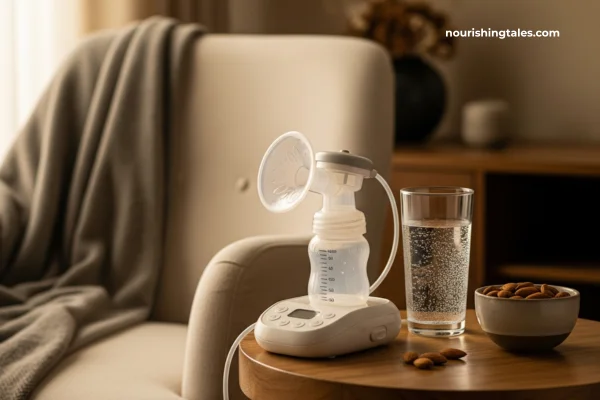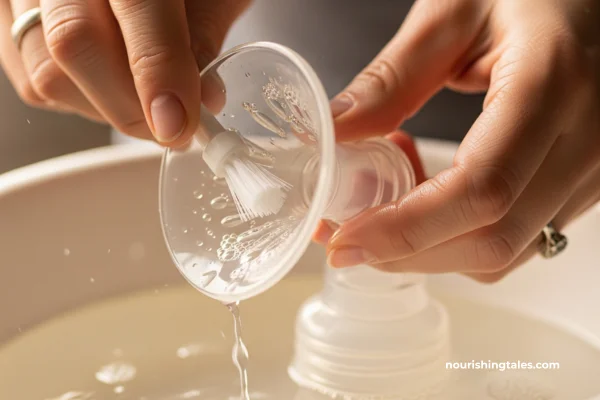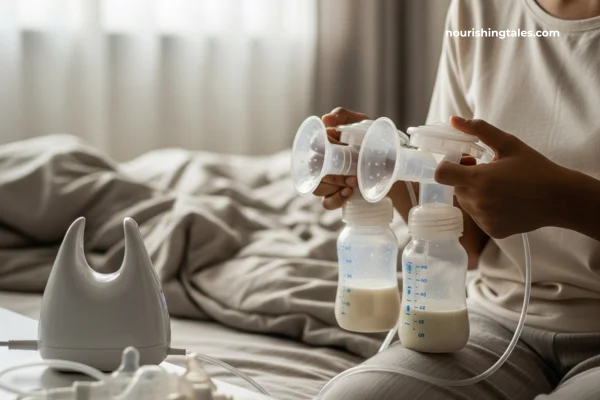
Preparing for a new baby brings a whirlwind of decisions, and navigating the world of breast pumps can feel like one of the most confusing. With countless models, features, and opinions, it is easy to feel overwhelmed. This guide is designed to be a supportive conversation with a trusted expert, here to demystify the process, answer your questions, and empower you to find the perfect tool for your unique journey.
A breast pump is not a measure of success or a requirement for every parent; it is a tool to help you meet your feeding goals. The American Academy of Pediatrics (AAP) recommends exclusive breastfeeding for about the first six months, followed by continued breastfeeding with complementary foods for two years or beyond. For many families in the USA, pumping is the key that makes achieving these goals possible, offering flexibility, support, and peace of mind. This guide will walk you through everything you need to know, from understanding your personal needs to choosing a specific model and using it with confidence.
Understanding Your Pumping Needs
Before looking at a single product, the most important step is to understand your own lifestyle and feeding aspirations. The best pump on the market is only the best if it fits your specific situation. This section will help you build a personal “pumping profile” to guide your choice.
Do I Even Need a Breast Pump?
Many first-time parents feel an implicit pressure to buy a top-of-the-line pump “just in case,” which can lead to unnecessary expense and anxiety. The reality is that not every mother needs a breast pump, and for some, simple hand expression is a perfectly effective option for occasional use. The most empowering first step is to shift the question from “What’s the best pump?” to “What is the best tool for my specific situation?”
According to lactation experts, the need for a pump typically falls into one of these common scenarios:
- Returning to Work or School: If you plan to be regularly separated from your baby, a pump is essential for maintaining your milk supply and providing breast milk for your baby’s feedings while you are away. This is one of the most common reasons mothers pump and generally requires a durable and efficient double electric pump.
- Exclusive Pumping: If your baby will receive expressed milk for all or most feedings, a high-quality pump is your primary tool. This may be a personal choice or due to circumstances like latching difficulties, certain medical conditions, or a prolonged separation after birth. This journey requires the most robust and reliable pump available, often starting with a hospital-grade rental to establish supply.
- Occasional Separations: If you are primarily nursing directly but want the flexibility for a partner or caregiver to offer a bottle, or if you plan to be away for a date night or appointment, a pump can help you build a small stash of milk. For this infrequent need, an inexpensive manual pump or a simple single electric pump may be all you need.
- Managing and Building Milk Supply: A pump can be a critical tool for addressing supply concerns. It can be used to increase a low milk supply, help manage a painful oversupply or engorgement, or even induce lactation for a non-birthing parent. In these cases, a hospital-grade or a high-powered double electric pump is often recommended by lactation consultants.
- Medical Necessity: If your baby is born prematurely, requires a stay in the Neonatal Intensive Care Unit (NICU), or has a health condition that prevents direct nursing, a hospital-grade pump is the clinical standard. It is designed to effectively initiate and build a milk supply when direct breastfeeding is not possible.
By identifying which of these scenarios most closely matches your own, you can immediately narrow down the vast market to the category of pumps that will best serve you, preventing financial waste and reducing the mental load of your decision.
The 4 Main Types of Breast Pumps
Once you have a clearer picture of your needs, you can confidently explore the main categories of breast pumps. Each type is designed for a different level of use and lifestyle.
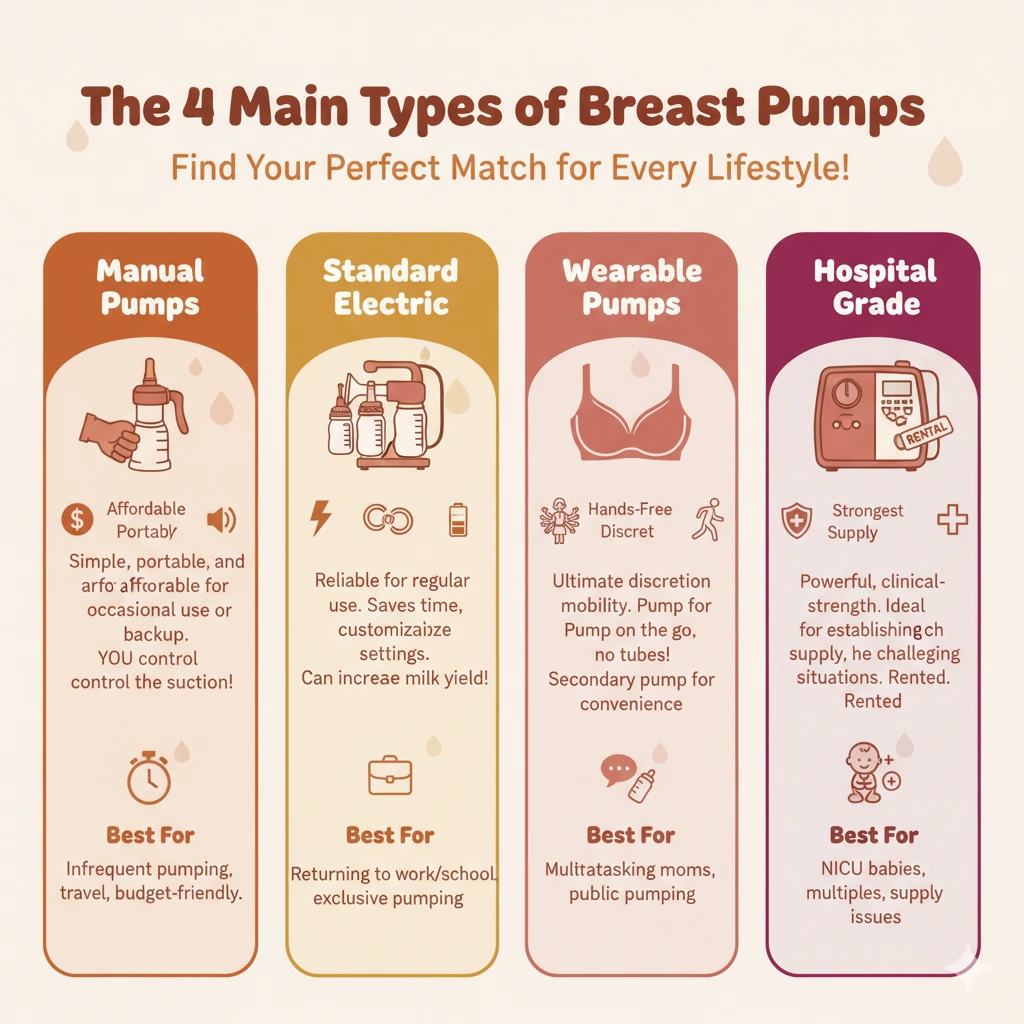
Manual Pumps
- How They Work: You manually operate a handle or lever to create suction and express milk.
- Pros: They are affordable, highly portable, lightweight, and silent. Because they do not require electricity or batteries, they can be used anywhere and are great for travel or as a backup during a power outage. They also offer you complete control over the pumping speed and suction, which some mothers find helps them learn their body’s milk flow patterns.
- Cons: Pumping requires continuous physical effort, which can be tiring, especially for longer sessions. Since they are almost always single pumps, it takes longer to empty both breasts.
- Best For: Mothers who plan to pump infrequently (once a day or less), for short-term use, or those looking for a discreet and affordable travel or backup option.
Standard Electric Pumps (Powered Pumps)
- How They Work: An electric motor creates the suction. Most models are double pumps, allowing you to express milk from both breasts at the same time. They can be powered by a wall outlet or, in some cases, a rechargeable battery.
- Pros: These pumps are significantly faster and more efficient than manual pumps, making them ideal for regular use. Double pumping not only saves a tremendous amount of time but has also been shown to yield up to 18% more milk on average, with a higher fat and calorie content. They offer consistent suction and a wide range of customizable settings for speed and strength.
- Cons: They can be bulkier and noisier than other types. Models without a built-in battery require you to be near a power outlet, limiting portability.
- Best For: Mothers returning to work or school, those who are exclusively pumping, and anyone who needs to pump regularly to establish and maintain their milk supply.
Wearable Pumps
- How They Work: These are a specialized type of electric pump where the motor and milk collection system are combined into a compact unit that fits entirely inside your bra, with no external tubes or wires.
- Pros: Their primary advantage is unparalleled discretion and mobility. They allow you to pump hands-free while multitasking—whether you are in a work meeting, commuting, or caring for your baby.
- Cons: Wearable pumps are among the most expensive options. Some users find they do not empty the breast as effectively as a traditional electric pump, which can be a concern for milk supply, especially if used exclusively before supply is well-established. They can also be trickier to position correctly for an optimal fit and may be more prone to leaking with certain movements.
- Best For: Multitasking mothers who need a discreet option for pumping on the go, at work, or in public. They often serve best as a secondary pump for convenience once a mother’s milk supply is regulated.
Hospital-Grade Pumps
- How They Work: These are powerful, durable, multi-user pumps designed for clinical settings and are typically rented rather than purchased. They are approved by the FDA for use by multiple people because they feature a “closed system” design that prevents any cross-contamination. Each user has their own sterile milk collection kit.
- Pros: They have the strongest, most efficient motors, which are clinically proven to be highly effective at initiating, building, and maintaining milk production, especially in challenging situations.
- Cons: They are large, heavy, and not designed for portability, requiring a power outlet. Purchasing one is prohibitively expensive for most families, with costs ranging from $500 to over $2,000.
- Best For: Specific medical indications, such as a premature baby in the NICU, twins or other multiples, or for mothers with significant supply issues. A lactation consultant may recommend renting one for the first few weeks to establish a robust supply before transitioning to a personal pump.
What Features Actually Matter?
Pump manufacturers often use technical jargon that can be confusing. Understanding what these features are and why they matter will help you cut through the marketing noise and focus on what will truly benefit you.
Closed vs. Open Systems
- What it is: A “closed system” pump has a physical barrier, often called a backflow protector, that prevents milk from overflowing and entering the pump’s tubing or motor. An “open system” pump does not have this barrier.
- Why it matters: This feature is primarily about hygiene. It prevents moisture and milk particles from creating a breeding ground for mold or bacteria in the hard-to-clean tubing and motor. This is why all hospital-grade pumps are closed systems, making them safe for multiple users. For personal use, it provides peace of mind and often allows for more comfortable, reclined pumping positions without fear of milk backing up.
- The Expert Nuance: While a closed system is a desirable feature, it is important to know that “closed system” is not a regulated medical term, and proper, consistent cleaning of all pump parts that touch your milk is the most critical factor for hygiene, regardless of the pump type. The risk of contamination with a properly maintained open-system pump is considered extremely small.
2-Phase Expression Technology
- What it is: This is a now-standard feature on most electric pumps, designed to mimic a baby’s natural nursing rhythm. It involves two distinct modes:
- Stimulation Mode (or Massage/Let-down Mode): This initial phase uses fast, light, fluttery suction patterns to stimulate the nerves in the breast and trigger the milk ejection reflex, commonly known as the “let-down”. This is similar to how a baby sucks quickly at the beginning of a feed.
- Expression Mode: Once milk begins to flow, this phase uses a slower, deeper, and stronger sucking pattern to efficiently remove milk from the breast.
- Why it matters: This technology makes pumping more efficient and effective, helping mothers express more milk in less time by working with the body’s natural reflexes.
- Pro Tip: Most pumps are programmed to automatically switch from stimulation to expression mode after two minutes. However, you should switch modes manually as soon as you see your milk start to flow, which can happen much sooner. To maximize output, you can also toggle back to the stimulation mode later in your session to encourage a second or third let-down when milk flow slows.
Suction Strength (mmHg) and Speed (Cycles)
- What they are: Suction, measured in millimeters of mercury ($mmHg$), refers to the strength or intensity of the pump’s pull. Speed, measured in cycles per minute (CPM), refers to how many times the pump sucks and releases in one minute.
- Why it matters: The ability to customize these settings allows you to find a rhythm that is both comfortable and effective for your body. However, the pump market often creates a narrative that more power is better, which is not only incorrect but can be harmful. Pumping should never be painful. The let-down reflex is driven by the hormone oxytocin, which is released when you are relaxed and comfortable; pain and stress can actually inhibit this reflex and reduce milk flow. Setting the suction to a painful level in the belief that “stronger is better” can lead to nipple damage, reduced output, and a frustrating cycle that can undermine your pumping goals. The goal is not to find the highest setting you can tolerate, but to find the highest comfortable setting that most effectively removes milk.
The 5 Best Breast Pumps For First Time Moms
Based on clinical evidence, expert recommendations, and real-world parent feedback, these are the top-performing pumps that consistently deliver results for first-time moms.
Best All-Around Electric Pump: Spectra S1 Plus vs. S2 Plus
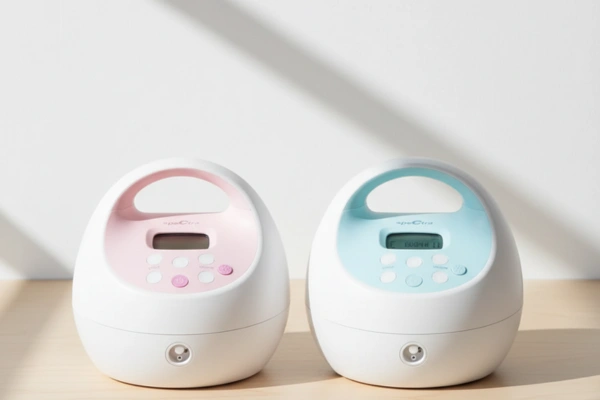
The Spectra S1 and S2 are overwhelmingly the most recommended double electric pumps for new mothers, beloved by both parents and lactation consultants for their performance, comfort, and reliability. They are functionally identical in every way but one.
- Shared Excellence: Both the S1 and S2 are closed-system pumps marketed with “hospital-strength” suction up to $270mmHg$. Their defining feature is an ultra-quiet motor, operating at just 45 decibels (the level of a quiet library), which is a significant advantage for nighttime pumping or use in an office. They are highly customizable, with 12 levels of suction in expression mode, 5 levels in massage mode, and adjustable cycle speeds, allowing each user to find her perfect settings. Both models also include a built-in nightlight and a timer on an LCD screen.
- The Deciding Factor: Portability vs. Price: The only functional difference is the battery. The Spectra S1 Plus (blue) has a built-in rechargeable battery that provides up to three hours of pumping time, freeing you from the wall outlet. The Spectra S2 Plus (pink) must be plugged in to operate. This portability comes at a cost: the S1 is slightly heavier (3 lbs vs. 2.5 lbs) and typically requires an out-of-pocket “upgrade fee” through insurance, while the S2 is often fully covered.
- The Verdict: For mothers who plan to pump frequently, user feedback is clear: the freedom of the S1’s battery is a “game changer” and “well worth the additional cost”. The ability to pump on the couch, in the car, or move around the house without being tethered to a wall significantly improves the pumping experience. If your budget is tight or you know you will always be pumping in the same spot next to an outlet, the S2 offers the exact same excellent performance for a lower price.
| Feature | Spectra S1 Plus | Spectra S2 Plus |
| Portability | Yes, built-in rechargeable battery (up to 3 hrs) | No, must be plugged into a wall outlet |
| Suction Strength | Up to $270mmHg$ | Up to $270mmHg$ |
| System Type | Closed System | Closed System |
| Weight | 3 lbs | 2.5 lbs |
| Color | Blue | Pink |
| Insurance Coverage | Typically requires an out-of-pocket upgrade fee | Often fully covered at no cost |
| Best For | Moms who want the flexibility to pump anywhere | Moms who will primarily pump at home near an outlet and want to maximize insurance coverage |
Best for Portability & Power: BabyBuddha 2.0
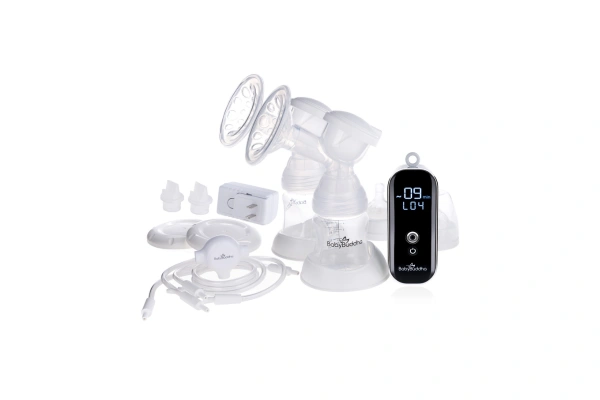
The BabyBuddha fills a unique niche, offering the power of a traditional pump in a remarkably small package.
- The Profile: The BabyBuddha is an incredibly compact and lightweight (less than 1 lb) closed-system pump with a rechargeable battery. It comes with a lanyard so it can be worn around the neck, offering excellent hands-free mobility.
- The Power: This pump is famous for its powerful and unique suction pattern, with a strength of up to $320mmHg$. Its original stimulation mode features a series of short pulls followed by one long, strong pull that many users find exceptionally effective at triggering a fast let-down and emptying the breast quickly.
- The 2.0 Upgrade: The intensity of the original model was a significant drawback for many. The BabyBuddha 2.0 addressed this by adding a “soft stimulation mode,” which feels more like a traditional pump and makes it much more comfortable and accessible for a wider range of users. This update has been widely praised by lactation experts.
- The Caveat: Even with the new soft mode, the BabyBuddha’s suction is potent and can be too intense for those with sensitive nipples, especially on the higher settings. It is also noticeably louder than a Spectra pump.
- Best For: A working mom who needs a highly portable yet powerful pump for the office, or any mother who prioritizes efficient milk removal and portability and knows she responds well to strong suction.
Best for Ultimate Discretion: Elvie Pump vs. Willow Go
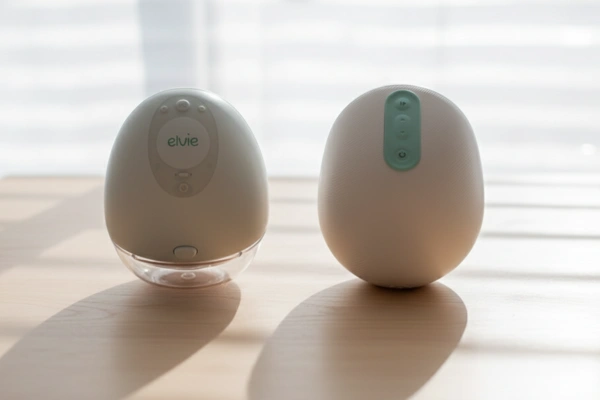
Wearable pumps represent a trade-off between ultimate convenience and, for some users, pumping efficacy. They are best understood not as a direct replacement for a traditional pump, but as a secondary tool that provides unparalleled freedom.
Using one exclusively to establish a milk supply is not recommended, as their design can make it harder to ensure complete milk removal, which is the key signal for your body to produce more milk. For the mom with an established supply who needs to pump on the go, however, they can be life-changing.
- Elvie Pump: The Elvie is the pioneer in this category, known for being the smaller, lighter, and quieter option. Its gentle suction (max ~$220mmHg$) and sophisticated app—which allows for remote control and real-time milk volume tracking—make it a popular choice. However, it is the more expensive of the two and is known to leak if the user bends over too far.
- Willow Go: The Willow Go is a more affordable alternative that offers significantly stronger, “hospital-grade” suction (max $280mmHg$) and higher-capacity collection cups. It is larger and heavier than the Elvie, and its app is far less functional, acting mostly as a timer. However, its stronger suction may be more effective for some users, and it is generally considered more secure against leaks with moderate movement.
| Feature | Elvie Pump | Willow Go |
| Price (approx.) | $550 | $329 |
| Suction Strength | Up to $220mmHg$ (Gentler) | Up to $280mmHg$ (Stronger) |
| Discretion | Smaller, lighter (7.4 oz), and whisper-quiet | Larger, heavier (13.6 oz), and more audible |
| App Functionality | Robust: Remote control, real-time volume tracking | Basic: Primarily a session timer |
| Leak-Proof Mobility | Prone to leaks when bending over | Leak-proof with up to 45° of movement |
| Warranty | 2 years | 1 year |
| Best For | Moms prioritizing maximum discretion and quietness, who respond to gentle suction | Moms wanting stronger suction and a lower price point, who can tolerate more bulk and noise |
Best for Occasional Pumping & Budget: Our Favorite Manual Pumps
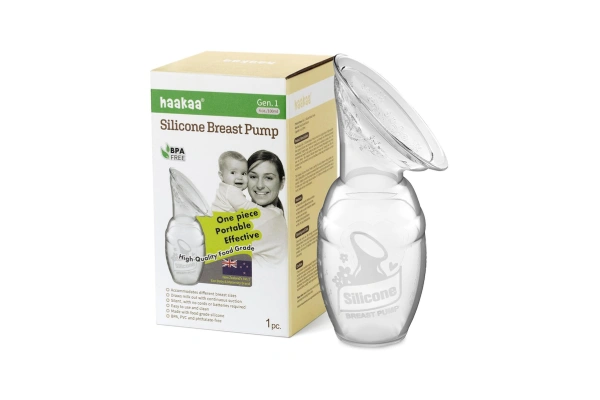
For the mom who only needs to pump occasionally for a date night or to relieve engorgement, a full electric setup is often unnecessary.
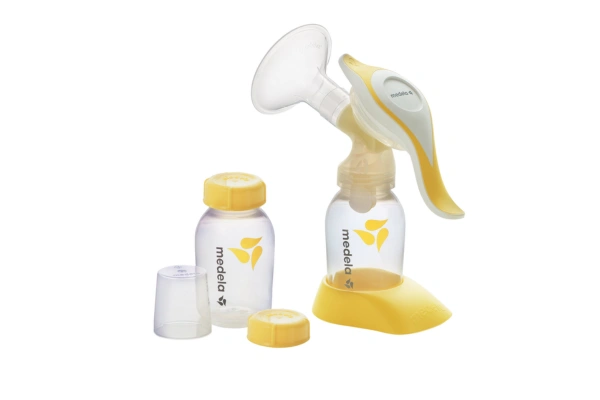
- Medela Harmony: This is a classic manual pump that uses 2-Phase Expression technology, allowing you to mimic the stimulation and expression phases with the handle. It is an effective, affordable, and portable option for active, occasional pumping.
- Haakaa (Silicone Milk Collector): This is not a traditional pump but a brilliant tool that uses gentle, passive suction. You attach it to the breast you are not nursing on to collect the let-down that would otherwise be lost in a breast pad. It is an effortless way to build a freezer stash, relieve engorgement, and help clear clogged ducts.
Special Mention: When to Rent a Hospital-Grade Pump
While most mothers will do well with a personal-use pump, there are specific situations where renting a hospital-grade pump, such as the Medela Symphony, is the medically indicated and superior choice. Consider renting if:
- You are exclusively pumping from day one.
- Your baby is born prematurely or is in the NICU.
- You are separated from your baby immediately after birth.
- You are trying to establish a milk supply for twins or other multiples.
- You have a diagnosed medical condition affecting milk supply or are trying to induce lactation.
The Medela Symphony features a research-based “Initiate” program designed specifically for the first five days after birth, which mimics a newborn’s unique feeding patterns to help establish a strong milk supply from the very beginning.
Getting Your Pump for Free (or Close!): A Step-by-Step Guide to US Insurance
Thanks to the Affordable Care Act (ACA), most private health insurance plans in the United States are required to cover the cost of a breast pump for nursing mothers. Navigating the process can seem daunting, but it is usually quite simple.
- Step 1: Get a Prescription. While not all plans require it, it is always a good idea to get a prescription for a “double electric breast pump” from your OB-GYN or midwife during your third trimester. This will prevent any delays later on.
- Step 2: Work with a DME Supplier. The easiest way to get your pump is to use a Durable Medical Equipment (DME) supplier. Companies like Aeroflow, Edgepark, and Pumping Essentials act as a free concierge service. You simply go to their website, fill out a form with your insurance information, and they handle the rest. They will verify your coverage, contact your doctor for the prescription, handle all the paperwork, and show you exactly which pumps are available to you under your plan. This is far simpler than calling your insurance company directly.
- Step 3: Choose Your Pump (“Fully Covered” vs. “Upgrade”). The DME will present you with your options.
- Fully Covered: These are pumps that your insurance will cover at 100%. This typically includes several high-quality double electric models, like the Spectra S2.
- Upgrade: These are pumps with features your insurance considers non-essential conveniences, such as a rechargeable battery (like the Spectra S1) or a wearable design (like the Elvie or Willow Go). You will be offered these pumps for an out-of-pocket upgrade fee.
- Timing is Everything: Start this process around week 30 of your pregnancy. This leaves plenty of time for processing and shipping, ensuring your pump arrives well before your baby does.
Must-Have Accessories For Breast pumping
A few key accessories can transform your pumping experience from a chore into a more comfortable and manageable part of your routine.
- A Hands-Free Pumping Bra: This is a non-negotiable for anyone who needs to pump regularly. It holds the flanges securely in place, freeing your hands to work, read, eat, or simply relax. Top-rated options like the Kindred Bravely Sublime Hands-Free Pumping Bra and the Bodily “The Do Anything Bra” are praised for their comfort, support, and ease of use.
- Breast Milk Storage Bags: Look for bags that are durable, have a reliable double-zipper seal to prevent leaks, and are designed to freeze flat to save precious freezer space. Lansinoh bags are a popular and highly-rated choice, though some users find them flimsy when pouring milk. Momcozy and Kiinde are other well-regarded brands.
- On-the-Go Essentials: If you will be pumping away from home, create a dedicated pump bag with these items:
- A cooler bag with a contoured ice pack to safely transport your milk.
- Extra sets of pump parts, especially small, easy-to-lose pieces like duckbill valves and membranes. These parts wear out over time and replacing them regularly is key to maintaining good suction.
- Pump cleaning wipes or a spray for situations where you do not have access to a sink.
- A lactation massager, like the one from LaVie, which can help encourage a faster let-down and work through stubborn clogged ducts.
Conclusion
Choosing a breast pump is a deeply personal decision, and the best choice is the one that aligns with your body, your baby, and your life. By first understanding your own needs and then learning about the technology designed to meet them, you can move forward with confidence. This journey is a labor of love, and every drop you pump is a testament to your dedication.
Finally, the most valuable tip is to seek personalized support. If you have questions about which pump to choose, are struggling with flange fit, or encounter any challenges along the way, please reach out to an International Board Certified Lactation Consultant (IBCLC). These dedicated professionals are the gold standard in lactation care and can provide the one-on-one guidance to help you have the most successful and positive pumping experience possible.